
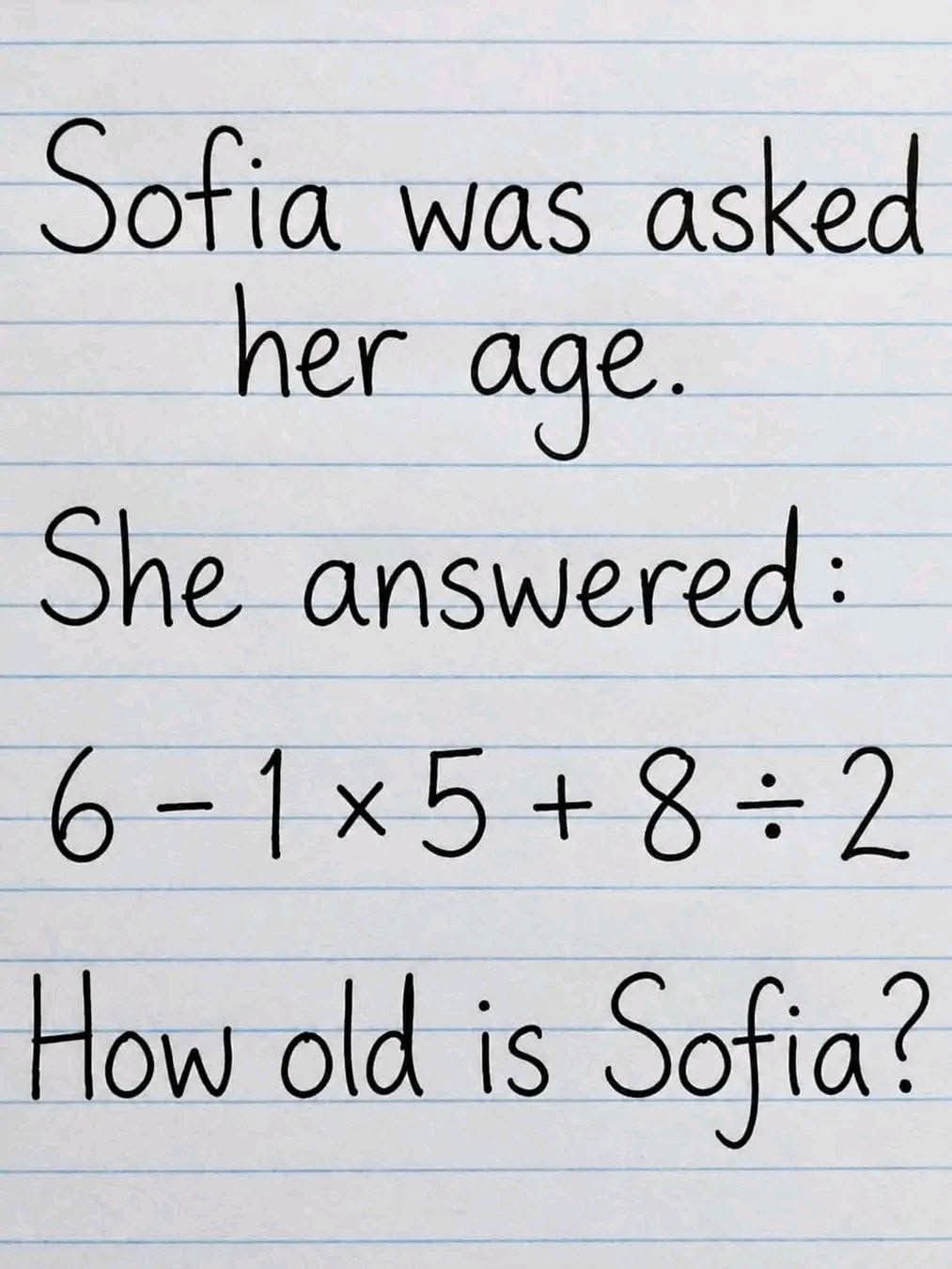
Sofia’s Math Puzzle: Can You Solve Her Age?
Mathematics is not just a subject but a way of thinking that helps improve problem-solving skills and logical reasoning. One of the intriguing aspects of math is puzzles that challenge our thinking and keep us engaged. In today’s article, we present an exciting puzzle called “Sofia’s Math Puzzle: Can You Solve Her Age?” This article will guide you through the problem, provide tips on how to approach similar puzzles, and discuss the importance of math puzzles for cognitive development. So, let’s dive into the intriguing world of Sofia’s age puzzle.
The Math Puzzle: Can You Solve Sofia’s Age?
Sofia has a unique way of revealing her age through a simple yet intriguing riddle. Here is the overview of the puzzle:
Sofia mentions, “If you multiply my age by 2 and then subtract 4, you will arrive at the number that is half of what my age will be next year.”
This riddle not only challenges your arithmetic skills but also encourages you to think critically about relationships and equations. Your goal is to figure out Sofia’s current age based on this statement.
Breaking Down the Puzzle
To solve this age-related math puzzle, let’s break down the statement into a mathematical equation.
1. Define Variables: Let Sofia’s current age be represented by the variable ( x ).
2. Translate the Statement into an Equation:
– If you multiply her age by 2: ( 2x )
– If you subtract 4: ( 2x – 4 )
– Her age next year will be: ( x + 1 )
– Half of her age next year: ( frac{x + 1}{2} )
Now, we can set up the equation based on her statement:
[
2x – 4 = frac{x + 1}{2}
]
Solving the Equation
Now, let’s solve the equation step by step:
1. Eliminate the Fraction: To make calculations easier, multiply all terms by 2 to remove the fraction:
[
2(2x – 4) = x + 1
]
This simplifies to:
[
4x – 8 = x + 1
]
2. Rearranging the Equation: Now, subtract ( x ) from both sides:
[
4x – x – 8 = 1
]
This simplifies to:
[
3x – 8 = 1
]
3. Isolate ( x ): Add 8 to both sides:
[
3x = 9
]
4. Final Calculation: Divide both sides by 3 to get Sophia’s age:
[
x = 3
]
So, after solving the equation, we find that Sofia is currently 3 years old.
Verifying the Solution
It’s critical to verify the solution to ensure its accuracy.
– Multiply her age by 2:
( 2 times 3 = 6 )
– Subtract 4:
( 6 – 4 = 2 )
– Calculate half of her age next year:
Next year, Sofia will be 4 years old. Half of this is ( frac{4}{2} = 2 ).
Both sides match, confirming that Sofia’s current age of 3 years is indeed correct.
Importance of Math Puzzles
Puzzles like Sofia’s age challenge contribute greatly to cognitive development. Here are some benefits:
Enhances Problem-Solving Skills
Working through puzzles forces individuals to think critically and find solutions systematically. This skill is not only applicable to academic subjects but also in real-life situations.
Promotes Logical Thinking
Mathematics is built on logic, and engaging with puzzles helps individuals develop their logical reasoning skills. This can make problem-solving more intuitive.
Encourages Persistence
Many puzzles are challenging and require time and effort to solve. Engaging with these puzzles teaches individuals the virtue of persistence in the face of difficulties.
Boosts Mathematical Understanding
For learners, solving age puzzles and other math-related riddles can enhance their understanding of fundamental mathematical concepts.
Tips for Solving Math Puzzles
To effectively engage with math puzzles like Sofia’s, consider the following tips:
1. Read the Puzzle Carefully: Understand every part of the statement before attempting to solve it. Take note of any mathematical terms or conditions mentioned.
2. Identify Key Information: Determine what is being asked and what information is provided.
3. Use Variables: Employ variables to represent unknowns, which allows for clearer equation formation.
4. Check Your Work: After arriving at a solution, work through the problem again to ensure accuracy.
5. Practice Regularly: The more puzzles you engage with, the better your problem-solving abilities will become. Set aside time to tackle different types of puzzles.
Conclusion
Sofia’s Math Puzzle is just one example of how age-related riddles can engage the mind and sharpen critical thinking skills. By taking a methodical approach to the problem, we not only derive Sofia’s age but also practice valuable math skills. Engaging with such puzzles can help cultivate a positive relationship with mathematics, making it both fun and educational.
Now that you’ve solved Sofia’s age puzzle, consider exploring other math puzzles or even creating your own. Embrace the joy of problem-solving and challenge yourself to think outside the box! Happy puzzling!