
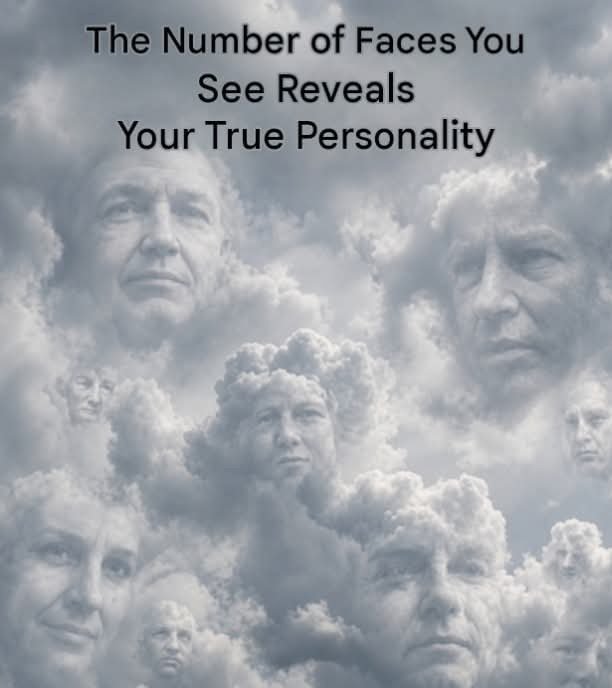
What the Number of Faces You See in This Cloud Image May Reveal About Your Personality
Pareidolia, the tendency of the human brain to perceive meaningful patterns such as faces in random stimuli, is one of the most fascinating features of human perception. Clouds, tree bark, electrical outlets, and rock formations all offer opportunities for the mind to find familiar shapes. Lately, online quizzes that ask people how many faces they see in a cloud image have spread rapidly across social platforms. The question is simple, but the claims attached to it are often bold: the number you count supposedly reveals hidden traits about your personality, emotional state, or social style.
This article explores what these cloud-face tests are, what psychology actually says about pattern recognition, and how you can approach such quizzes with curiosity rather than blind belief. Whether you are a curious reader, a content creator, or someone exploring personality assessment tools, understanding the science behind these images will help you get more value from them.
Understanding Pareidolia and Visual Pattern Recognition
Pareidolia is a well-documented phenomenon in cognitive psychology. The human visual system is highly specialized for detecting faces, a skill that helped our ancestors recognize friends, family, and threats quickly. Because of this sensitivity, the brain tends to fill in ambiguous shapes with facial features, especially eyes, noses, and mouths. Researchers have studied this effect using neuroimaging and found that areas of the brain associated with face processing, such as the fusiform face area, can activate even when no real face is present.
This means that seeing faces in clouds is a normal and universal experience. Nearly everyone sees something when they look at a cloud, though the number and clarity of what they see can vary widely. Factors such as attention, mood, fatigue, lighting, and even how much time you spend looking at the image all influence what your brain highlights.
Why People Are Drawn to Personality Quizzes
Personality quizzes remain enormously popular because they offer a sense of self-discovery in a quick and entertaining format. People enjoy reading descriptions that feel personally accurate, a phenomenon psychologists call the Barnum effect or the Forer effect, in which vague, broadly applicable statements are perceived as uniquely true. Cloud-face quizzes take advantage of this tendency by pairing an engaging visual puzzle with interpretations that many readers will find relatable.
These quizzes also appeal because they feel low-stakes. Counting faces in a picture requires no special knowledge and takes only seconds, which makes the results feel like a fun game rather than a formal assessment. However, the entertainment value and the scientific validity of a test are two very different things, and it is important to keep them separate.
What the Science Says About Cloud Face Tests
There is no peer-reviewed evidence that the number of faces you perceive in a cloud image reliably measures personality traits such as extraversion, openness, conscientiousness, agreeableness, or neuroticism. Established personality frameworks, such as the Big Five model, are built on extensive statistical research using validated questionnaires, large sample sizes, and repeated testing. Cloud images do not meet these standards.
That said, some researchers have explored whether individual differences in pareidolia correlate with other cognitive or emotional factors. Studies have suggested possible links between the tendency to perceive patterns and creative thinking, imaginative style, or certain attentional habits. These findings are preliminary and modest, and they do not justify treating a cloud quiz as a diagnostic tool. A person who sees many faces may simply have a highly active pattern-detection system, a vivid imagination, or a particular focus at that moment.
Common Interpretations Found Online
Most cloud-face quizzes assign meanings based on the number of faces you report. Those who see only one or two faces may be described as focused and practical, while those who see many faces are often labeled as creative, empathetic, or highly intuitive. Some quizzes suggest that a person who notices hidden details is perceptive or detail-oriented. These descriptions are usually written in flattering, general language that most people can connect with.
It is worth recognizing that these interpretations are created by the quiz authors and are not derived from measured data. They work because they are broad enough to apply to many people, and because readers naturally look for themselves in the descriptions. This does not make them harmful, but it does mean they should be read as entertainment rather than as insight grounded in evidence.
How to Enjoy Cloud Image Quizzes Responsibly
If you enjoy these quizzes, you can take part in them without treating the results as definitive. Here are a few practical approaches. First, count the faces you see honestly and then compare your answer with friends or family to see how different perceptions can be. This conversation often reveals more about how people think than the quiz result itself. Second, pay attention to how you felt while looking at the image. Were you relaxed, rushed, or curious? Your mood can shape what your mind notices. Third, use the quiz as a starting point for reflection rather than a final verdict. If a description resonates, consider whether it reflects behaviors you have actually observed in yourself.
For those who are genuinely interested in understanding personality, validated assessments provide far more reliable information. Tools developed by psychologists, such as the Big Five Inventory or the HEXACO model, ask detailed questions about your habits, preferences, and reactions across many situations. Combining these tools with self-reflection, feedback from trusted people, and perhaps guidance from a qualified professional can offer a much richer picture of who you are.
The Broader Lesson: Perception Is Shaped by the Mind
Cloud-face quizzes highlight a broader truth about human perception: we do not simply record the world as it is. Our brains actively interpret, organize, and sometimes invent what we see. This is part of what makes human cognition powerful, enabling creativity, empathy, and quick recognition. It also means that our first impressions and perceptions should be examined with some humility.
Seen in this light, the number of faces you find in a cloud can be an interesting window into the workings of your own mind, even if it is not a