
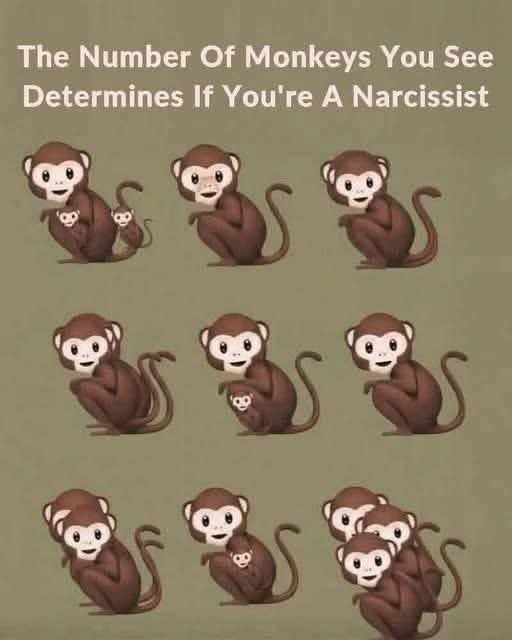
The Number Of Monkeys You See Determines If You’re A Narcissist
Are you constantly seeing monkeys in puzzles, optical illusions, or social media quizzes, and wondering what it says about your personality? Viral posts often claim that the number of monkeys you spot reveals whether you have narcissistic tendencies. Before you accept that conclusion, it helps to understand what these tests actually measure, what science says about narcissism, and how to evaluate personality claims online. This guide breaks it down clearly.
Where the Monkey Test Came From
The “monkey test” usually appears as a visual puzzle: an image filled with hidden or partially concealed monkeys, sometimes arranged among foliage, trees, or patterned backgrounds. The viewer is asked to count how many monkeys they can find, and then told that the number they report reveals something about their character. Some versions claim that spotting many monkeys signals high self-focus, while spotting few suggests humility.
These puzzles are designed for entertainment and engagement. They are built to hold attention, encourage sharing, and generate comments. They are not validated psychological instruments. No peer-reviewed research has established a link between the number of hidden animals a person counts and their level of narcissism.
What Narcissism Actually Means
To evaluate any personality claim, it helps to understand the construct being discussed. In psychology, narcissism refers to a personality trait that includes grandiosity, a need for admiration, a sense of entitlement, and in some cases a lack of empathy. Clinicians distinguish between a normal range of self-confidence and narcissistic personality disorder, which is diagnosed through structured clinical assessment and involves persistent, pervasive patterns that impair functioning.
Researchers commonly measure narcissism using standardized questionnaires such as the Narcissistic Personality Inventory, which asks respondents to rate statements about themselves. These instruments are based on self-report and are tested for reliability and validity. A single visual puzzle cannot replicate that level of measurement.
Why Visual Puzzles Can Feel Revealing
Many people find these tests persuasive because they feel personal. Several psychological effects make them seem accurate:
The Barnum effect is the tendency to accept vague, general descriptions as uniquely applicable to oneself. A statement like “you sometimes doubt your decisions but also take pride in your abilities” fits almost everyone, so readers feel recognized.
Confirmation bias leads people to remember results that match their self-image and forget those that do not. If the puzzle says you are self-focused and you already suspect this about yourself, the result feels true.
Perceptual variation is also real. Visual search ability differs across individuals based on attention, lighting, screen size, fatigue, and even eyesight. Counting hidden objects reflects these factors rather than character.
Why the Monkey Test Does Not Measure Narcissism
Several reasons explain why counting monkeys cannot reveal narcissism. First, the task measures visual attention and pattern recognition, which are cognitive skills, not personality traits. Second, there is no established scoring key linking specific counts to psychological profiles, and the numbers attached to results are typically arbitrary. Third, the puzzles lack reliability: the same person may find different numbers on different days or in different versions. Finally, narcissism is a multidimensional trait that requires assessment of behavior, relationships, self-perception, and emotional patterns over time.
How to Evaluate Personality Claims Online
Because social media is full of quizzes and “psychology facts,” it is useful to apply a few simple checks. Ask whether the claim cites credible research or only says “studies show.” Check whether the test has been validated in peer-reviewed journals. Consider whether the result would apply to almost anyone, which would suggest vague wording. Notice whether the quiz is designed to sell products, collect data, or drive ad impressions. Reputable sources such as university psychology departments, licensed clinicians, and professional organizations like the American Psychological Association offer more trustworthy information.
If You Are Concerned About Narcissistic Traits
Some people take these quizzes because they worry about how they treat others or how they see themselves. If that is your situation, more meaningful steps can help. Reflect on patterns in your relationships: do you often feel misunderstood, struggle to acknowledge others’ perspectives, or need constant praise? Ask trusted friends or family for honest feedback. Consider speaking with a licensed psychologist or counselor, who can conduct a thorough assessment using validated tools and discuss the results with you. Therapy approaches such as cognitive behavioral therapy and schema therapy have been used to address self-focused patterns and improve interpersonal functioning.
Building Healthier Self-Awareness
Self-awareness is valuable whether or not you have narcissistic traits. Practices that support it include journaling about your reactions in conflict, practicing active listening in conversations, seeking perspectives that differ from your own, and noticing when you feel the urge to defend your image. Self-compassion matters too: recognizing a flaw is different from condemning yourself for it, and growth often starts with honest reflection rather than harsh judgment.
Conclusion
The idea that the number of monkeys you see determines whether you are a narcissist is an entertaining internet trend, not a scientifically supported finding. Visual puzzles measure perceptual skill, not personality, and narcissism is a complex trait assessed through validated questionnaires and clinical evaluation. If you are curious about your own traits, rely on reputable psychological resources, honest feedback from people who know you, and professional guidance where appropriate. Treat viral quizzes as lighthearted distractions rather than reliable insight into who you are.