
Some picture puzzles are easy to understand but surprisingly difficult to solve. You may look at the image for only a few seconds and feel confident that you have found everything, only to discover that one tiny detail has been hiding in plain sight. The visual puzzle shown here is a perfect example.
At the top of the picture, four objects are displayed as clues: an egg, a comb, a nail, and a pill. The challenge is simple: find the hidden objects inside the kitchen scene below. The first three may seem relatively easy once you know what to look for, but the fourth object is deliberately concealed in a way that makes the puzzle much more challenging.
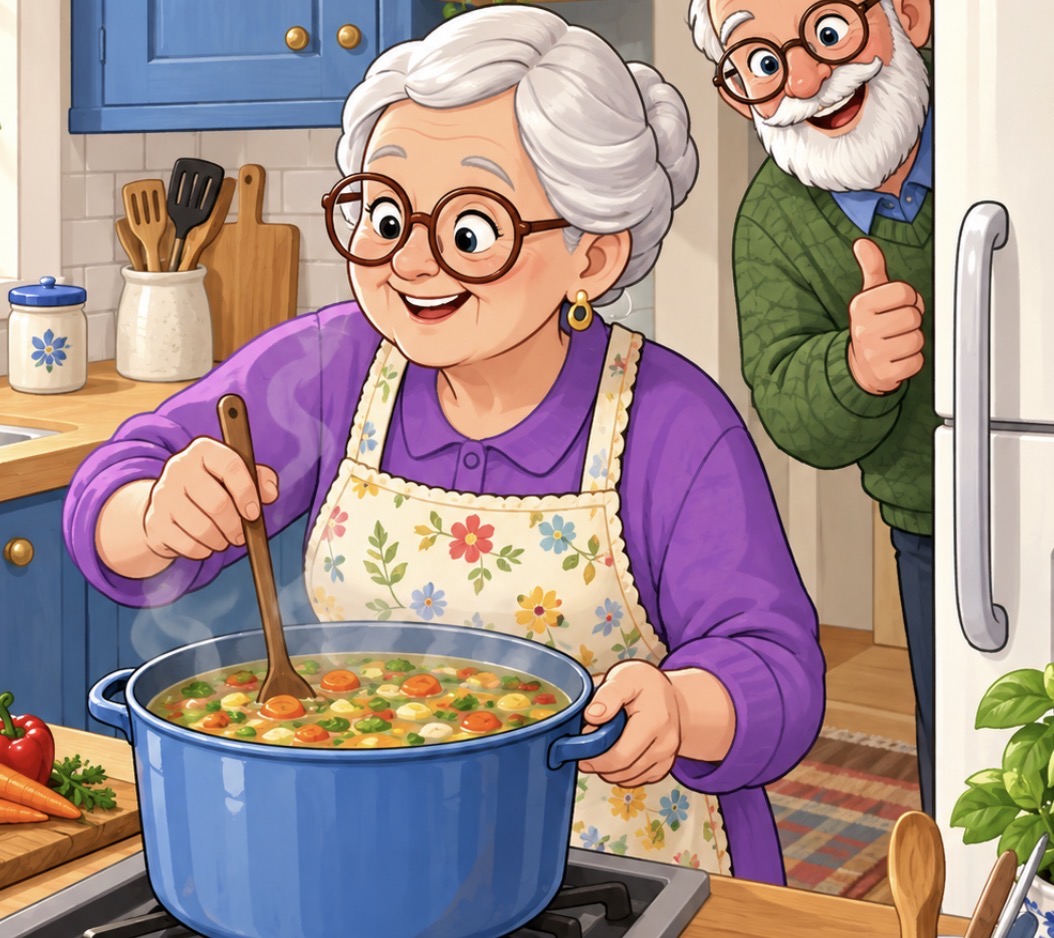
The illustration shows an elderly woman preparing food in a kitchen while an elderly man stands behind her, smiling and giving a thumbs-up. The scene contains cabinets, a countertop, cooking utensils, a refrigerator, containers, a clock, and several ingredients. With so many small details competing for your attention, it becomes surprisingly difficult to separate ordinary objects from the hidden clues.
The Challenge: Find the Fourth Object
The wording at the top of the image says, “I’m positive you can’t locate the 4th object.” That sentence is an important part of the puzzle because it encourages the viewer to question every detail.
The four reference objects are clearly illustrated:
- Egg
- Comb
- Nail
- Pill
The objective is not simply to find objects that look similar. Instead, the illustrator has incorporated the shapes into the surrounding environment. Some objects are partially hidden, blended into another object, or represented in an unexpected location.
That is what makes this type of puzzle more than a simple “Where’s the object?” game. It requires visual scanning, pattern recognition, attention to shape, and patience.
Start With the Egg
The egg is one of the easiest clues to recognize.
In the lower-left portion of the kitchen scene, there is a broken egg resting on the countertop. The brownish shell halves are separated, while the yellow yolk and white are visible between them.
This is a particularly clever placement because the egg is located close to the cooking area. Since the woman is preparing food, the presence of an egg does not immediately seem unusual.
That is one of the fundamental tricks used in hidden-object puzzles: the hidden item is often placed somewhere that makes logical sense.
If an egg appears in a kitchen, your brain does not automatically identify it as a puzzle clue. Instead, it simply interprets it as part of the scene.
This is known as contextual camouflage. The object is visible, but because it belongs naturally in the environment, the brain can overlook it.
Look Carefully for the Comb
The comb is more challenging because it does not necessarily appear as a normal hair comb sitting on a table.
The scene contains several objects with repeated lines and teeth-like shapes. One of the containers on the countertop has details that can draw your attention toward the comb clue.
The reference comb at the top has a rectangular body with a row of teeth underneath. When looking for it inside the illustration, it helps to stop thinking about the complete object and instead search for its distinctive pattern.
This is an important strategy for solving hidden-object puzzles.
Instead of asking:
“Where is a comb?”
ask:
“Where do I see a row of evenly spaced teeth?”
That change in thinking can make the puzzle much easier.
The human brain is excellent at recognizing familiar shapes, but it can also become distracted when those shapes are incorporated into larger objects. A comb hidden among kitchen equipment can therefore be much harder to spot than a comb lying openly on the countertop.
The Nail Is More Difficult
The nail presents another challenge because a nail is a very simple object.
Unlike an egg, which has a recognizable silhouette, or a comb, which has multiple teeth, a nail can be represented by little more than a straight shaft and a rounded or flat head.
This means the viewer must pay attention to small lines, handles, hardware, and decorative elements throughout the kitchen.
Look at the refrigerator, cabinets, countertop objects, utensils, and other parts of the illustration. The nail may be incorporated into the design rather than presented as a realistic metal nail.
This is another common technique in visual puzzles: changing the scale or context of an object.
A familiar item may be drawn much smaller than expected, or it may be integrated into something else. If you only search for an ordinary nail, you can easily miss it.
And Then Comes the Pill
The pill is particularly interesting because its shape is extremely simple: two rounded halves joined together, usually with contrasting colors.
There is a small capsule-like detail visible around the left side of the countertop area, close to the clock. Because it is tiny compared with the main characters, it is easy to overlook when first examining the scene.
This demonstrates why these puzzles often reward people who scan the image systematically instead of simply staring at the center.
Most people naturally look first at the faces of the characters. The elderly woman and man occupy a large portion of the picture, so their faces attract attention immediately.
But the hidden objects are scattered around the edges and background.
That means the best strategy is often to begin with the corners rather than the center.
Why Your Eyes Can Miss Something That Is Clearly Visible
One of the fascinating aspects of hidden-object puzzles is that the difficulty is not necessarily caused by poor eyesight.
Even when an object is technically visible, the brain may fail to notice it because attention is selective.
When you look at a complicated image, your brain cannot consciously process every detail equally. It prioritizes information that appears important.
In this illustration, the most visually important elements are the two characters, the pot, the food, and the kitchen.
Your brain quickly recognizes:
- A woman cooking.
- A man standing behind her.
- A pot on a stove.
- Food inside the pot.
- Kitchen cabinets.
- A refrigerator.
- Countertop objects.
Once your brain establishes that interpretation, smaller details can fade into the background.
This is why hidden-object puzzles can feel almost unfair. The object may be sitting right in front of you, but your brain has already decided that the surrounding area is not important.
The Power of Visual Camouflage
The illustrator uses several forms of camouflage in this image.
The first is color camouflage. Objects can share colors with their surroundings, making their edges less obvious.
The second is shape camouflage. A hidden object can be incorporated into another object with a similar outline.
The third is contextual camouflage. The object is placed somewhere where you would not normally expect to search for it.
The fourth is scale camouflage. An object may be much smaller or larger than you expect.
All four techniques can make a simple puzzle surprisingly difficult.
A Better Way to Solve Hidden-Object Puzzles
If you are struggling with this picture, do not keep staring randomly at the screen.
Instead, use a systematic approach.
Step 1: Divide the Image Into Sections
Imagine the picture divided into a grid.
Start with the upper-left corner, then move across the image. Continue through the middle and lower sections.
This prevents your eyes from repeatedly returning to the same areas.
Step 2: Search for Shapes
Do not initially search for the object itself.
Search for its shape.
For the egg, look for an oval or broken shell.
For the comb, look for repeated teeth.
For the nail, look for a straight shaft with a small head.
For the pill, look for a small capsule divided into two sections.
Step 3: Check the Background
Many people concentrate on the characters and ignore the background.
That is often a mistake.
Look carefully at:
- Cabinets
- Shelves
- Counters
- Containers
- Appliances
- Doors
- Handles
- Decorative objects
- Small items near the edges
Hidden-object puzzles frequently use background details because viewers naturally give them less attention.
Step 4: Look at Objects From a Different Perspective
If you cannot find something, stop asking what the object would normally look like.
Ask what it might look like when incorporated into another object.
A comb could resemble a series of lines.
A nail could resemble a handle or decorative detail.
A pill could resemble a tiny capsule or button.
This mental flexibility is one of the most useful skills for solving visual puzzles.
Why the Fourth Object Feels Impossible
The phrase “I’m positive you can’t locate the 4th object” creates an interesting psychological effect.
It challenges the viewer directly.
Instead of simply asking you to find four objects, it tells you that the fourth will be difficult. This increases your attention but can also increase frustration.
You may begin searching more aggressively, moving your eyes quickly across the image.
However, speed is not always helpful.
In fact, hidden-object puzzles often become easier when you slow down.
Take a few seconds to examine each object individually. Look at its edges. Look for unusual shapes. Pay attention to small items that seem slightly out of place.
The goal is not to look harder.
The goal is to look differently.
The Kitchen Is Full of Distractions
The setting of the puzzle is particularly effective because kitchens naturally contain many small objects.
There are jars, containers, utensils, appliances, cabinets, food ingredients, and cooking equipment.
The woman is holding utensils while stirring or preparing the contents of a large pot. The stove occupies the foreground. Behind her, the man adds another focal point.
The refrigerator on the right also contains small details and decorations.
All of these elements create visual noise.
When there are many objects in an image, the brain quickly categorizes them. Once something is classified as “ordinary kitchen detail,” you may stop consciously examining it.
That is exactly what a good hidden-object puzzle takes advantage of.
Don’t Ignore the Corners
One of the most useful general rules for puzzles like this is:
Always inspect the corners.
People tend to focus on the center because that is where the main action happens.
In this illustration, the central characters and cooking pot immediately attract attention. But the corners contain important information too.
The lower-left corner contains the broken egg.
The upper-left area contains small countertop details.
The right side contains the refrigerator and its decorations.
The lower-right corner contains another kitchen object.
When solving a visual puzzle, the perimeter can be just as important as the center.
What Makes These Puzzles So Addictive?
Hidden-object puzzles are popular because they provide a small but satisfying mental challenge.
There is no complicated equipment required. You simply look at an image and try to solve it.
When you finally discover the hidden item, you experience a small moment of success.
The puzzle also encourages people to compare observations. Someone may stare at the picture for several minutes without success, while another person notices the hidden clue almost immediately.
That difference makes these puzzles especially enjoyable to share with family and friends.
You can show the image to someone else without giving them the answer and see how quickly they can find the objects.
A Fun Challenge for Friends and Family
This image works particularly well as a group challenge.
Try showing it to several people and asking them to find all four objects without giving away any clues.
Give everyone a time limit, such as two or three minutes.
The important rule should be that nobody reveals the location until the time is over.
At the end, compare what everyone discovered.
Some people will immediately notice the egg. Others may focus on the background and discover one of the smaller clues first.
This can create a surprisingly entertaining conversation because everyone tends to see the same image differently.
The Lesson Behind the Puzzle
Although this is primarily a fun visual challenge, it also demonstrates something important about perception.
Seeing is not always the same as noticing.
Our eyes collect enormous amounts of visual information, but our attention determines what reaches conscious awareness.
That is why you can look directly at something and still fail to recognize it.
The hidden-object puzzle takes advantage of this natural limitation.
It places familiar objects into an environment where they do not immediately attract attention. The challenge is therefore not simply visual—it is also attentional.
Final Thoughts
The kitchen scene may look simple at first glance, but it contains a surprising amount of detail. The elderly woman cooking, the smiling man behind her, the cabinets, stove, refrigerator, jars, utensils, and food all compete for your attention.
Meanwhile, the four reference objects—egg, comb, nail, and pill—are waiting to be discovered.
The easiest way to solve the puzzle is to slow down, divide the image into sections, search for shapes rather than complete objects, and pay special attention to tiny details in the background.
Most importantly, do not assume that an object must look exactly like the example at the top. The illustrator may have changed its scale, orientation, color, or context.
And if you have already found the obvious objects, take another careful look at the small details around the countertop and background. The fourth clue is designed to be the one that makes you question whether you have really examined the entire picture.
That is what makes this puzzle so enjoyable. It reminds us that sometimes the hardest things to find are not hidden far away—they are right in front of us, disguised by everything else we are already looking at.